Less time on logistics, more time changing lives: a platform for global surgical missions
My role
As the sole freelance product designer, I redesigned the information architecture and UI based on an existing prototype, developed the branding and logo, digitalized and restructured complex medical forms, and collaborated closely with the client and developer throughout the process.
The organization
Global Rounds is a medical NGO that conducts surgical missions for children in Honduras, Ecuador, and Ethiopia.
The team
Remote collaboration with the NGO founder and a developer who implemented the final designs.
Overview
Giving 14 years of medical mission work a professional home
Global Rounds treats between 6 and 40 patients per trip with a team of 5–8 surgeons, nurses, and volunteers. Each mission involves multiple layers of coordination: coordinating logistics, tracking patient histories across multiple visits, documenting complex surgical protocols, and maintaining ongoing contact with both patients and local medical teams after the mission ends.
The founder had already built a working prototype to manage logistics, patient protocols, and knowledge sharing, what he needed was a professional designer to give it a polished UI. But once I started working, it became clear the information architecture also needed attention to making the UI actually intuitive, not just visually cleaner, and since the prototype only covered desktop, tablet and mobile layouts had to be designed from scratch.
The challenge
A working prototype with an incomplete experience
The interface needed clearer structure, better information hierarchy, and more thoughtful interaction design, especially for doctors with diverse technical backgrounds working in low-connectivity environments. The most critical piece was data entry: the medical forms existed as unstructured Word files, with no grouping, no defined input types, and no way to handle conditional information. In a clinical context, a form that's hard to fill out isn't just an inconvenience, incomplete or incorrectly entered data can directly affect patient care.
The goals
Improving the experience without losing the clinical depth
The goal was to redesign the interface and information architecture to make the platform feel professional, lightweight, and easy to navigate, without simplifying away the medical complexity the team actually needed. This meant reorganizing how information was displayed across screens, and completely rethinking how data was entered through the forms.
The design decisions
Bringing order to complex, data-heavy interfaces
From unstructured Word files to carefully designed clinical workflows
The forms were the most complex and most important part of this project. The prototype didn't include designed forms for the patient flows, which were the most complex ones, and the remaining forms also needed a full redesign, so I was essentially starting from zero, translating clinical documents into digital workflows while making sure no medical detail was lost in the process.
Starting from flat, unstructured Word documents that were used to collect patient information, I used AI to regroup and reorder the questions into logical sections, then went through everything with the founder to validate the clinical logic and decide the right input type for each field: dropdown, free text, radio button, or multiple choice. From there, I broke each form into a multi-step flow with named steps so users always know where they are and how many steps are left, covering four flows: adding a mission, a participant, a patient, and an interval event to document operating room evaluations.
Three principles shaped every form in the platform:
Progressive disclosure
Each step only shows what's relevant at that moment, keeping the form from feeling overwhelming.
Conditional logic
Certain fields appear only based on previous answers. The gynecology section in the patient intake, for example, only shows if the patient's sex is female. This keeps the form clean without removing any clinical detail.
Dynamic fields
Sections like medications, procedures, and tests use "+ Add another" buttons, so the form adapts to each patient's complexity instead of forcing a fixed number of rows.
From data entry to data display
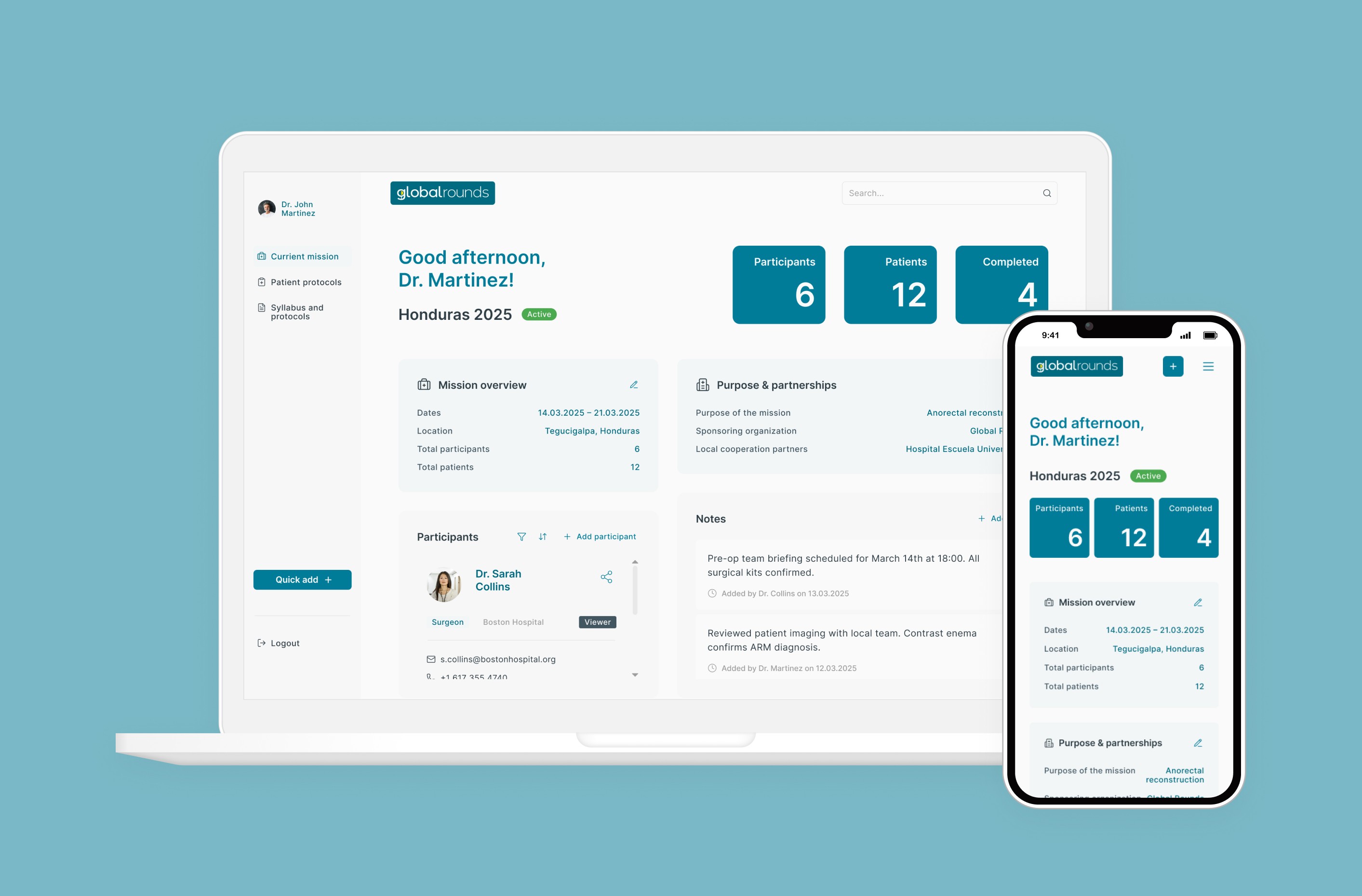
With the forms handled, the other major challenge was displaying all of that information clearly across the platform, without overwhelming users working quickly in the field with limited connectivity. The approach throughout was the same: surface what matters most, and reveal the rest progressively. Bento grids to group related information visually, tabs to separate content that doesn't need to be visible at once, expandable rows for detail that's needed sometimes but not always, and consistent card patterns that make key information scannable at a glance.
The patient protocol was the most complex screen to apply this to. Each patient record holds personal information, a medical plan overview, a photo for quick recognition, documents, and four layers of clinical detail. I used a bento grid for the top section and four tabs for the deeper clinical content, each grouping related fields together. On mobile, expandable boxes combined with dropdowns keep everything accessible without cluttering the interface. The client also asked for a patient photo and I also added navigation arrows to move between patient records without going back to the list, adding small but meaningful details when managing several patients during a mission.
The branding
A medical identity that feels human, not sterile
A logo with a hidden language
The logo centers on a custom lettermark for the G in Global Rounds. The client asked for a scalpel in the logo, so I found a way to integrate it subtly into the shape of the letter, making it present but not literal, more of a visual suggestion than an explicit symbol. The same form also indirectly references the caduceus symbol for medicine, reinforcing the medical identity without spelling it out.
A minimal palette with medical roots
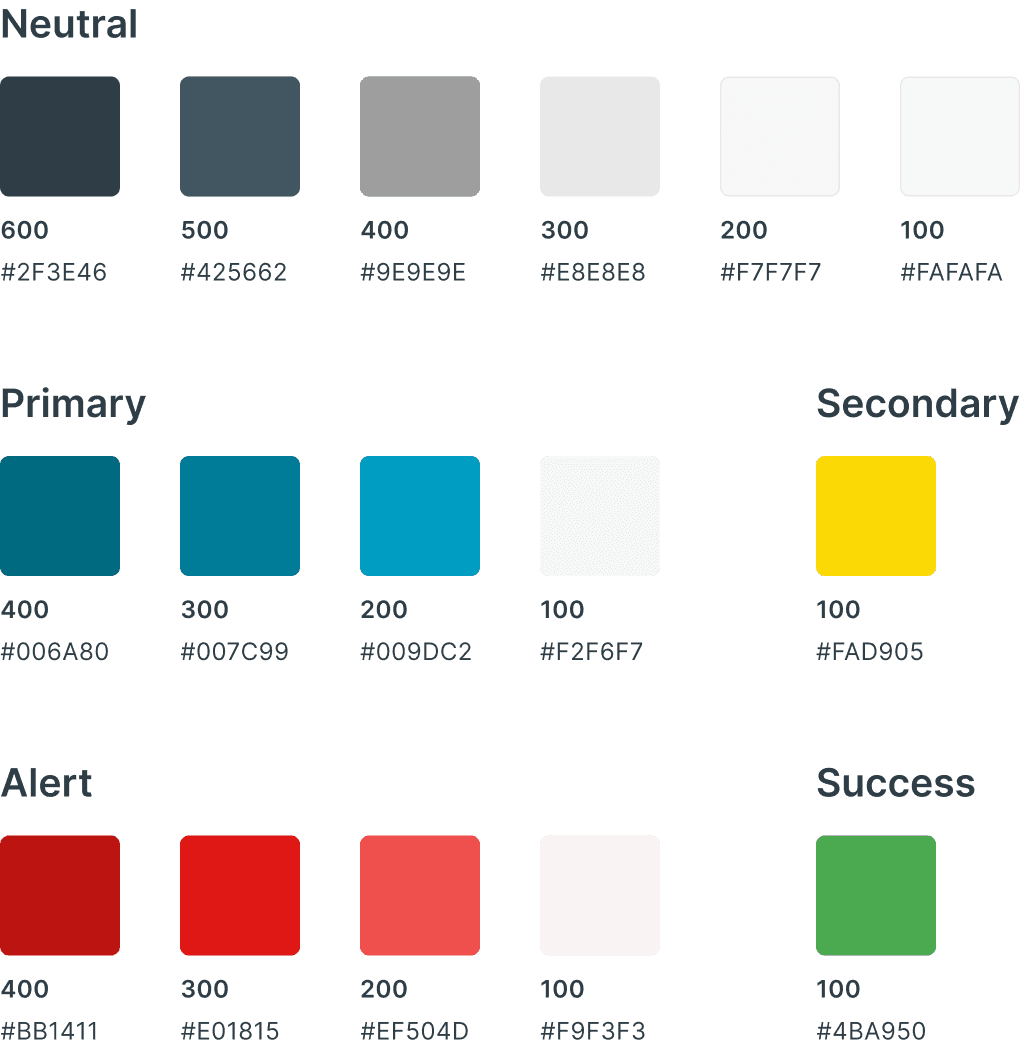
The branding needed to feel professional and trustworthy without being cold, especially for an NGO working with children, where an approachable feel matters as much as medical credibility. The color palette is built around turquoise, a color with strong medical associations, with yellow as a highlight to bring in warmth, and kept deliberately minimal to ensure the platform stays lightweight and fast even on low-bandwidth connections.
Reflections
What I took from this project
Working on a platform for a medical NGO brought a greater layer of responsibility than other projects I've worked on. Every design decision, especially in the forms, had real clinical implications, which pushed me to be more rigorous about information architecture.
Even though I believe I provided good solutions for displaying the dense medical data, I believe there's always a smarter way to present complex information. Given more time, I would have pushed further on the dashboard data visualization, turning the summary stats into more meaningful and actionable overviews for both the admin and the medical team.
Looking back at this project, one thing I'd change is the navigation in the patient protocol, which currently relies on arrows to move between records. Adding a search or jump-to dropdown would have made it significantly faster to reach a specific patient.